
- Scaling output almost always kills brand consistency — bold concepts become templates, distinctive voices go generic.
- Brand quality breaks down three ways: time pressure favors safe choices, brand review gets skipped, and teams interpret guidelines differently.
- Written guidelines aren't enough — descriptive language leaves too much open to interpretation.
- The fix: visual systems, continuous brand review, and aligning stakeholders on what they actually see.
- AI workflows are changing the math — assets that once took weeks can now be produced in minutes.
- Scale and quality can coexist, but only with workflows designed for both.
"Can we change the ending? Just the last 10 seconds."
It sounds like a minor request. The video is 90% done. The edit is locked. The voiceover is recorded. Legal already approved it. You're two days from delivery.
How expensive could one small change really be?
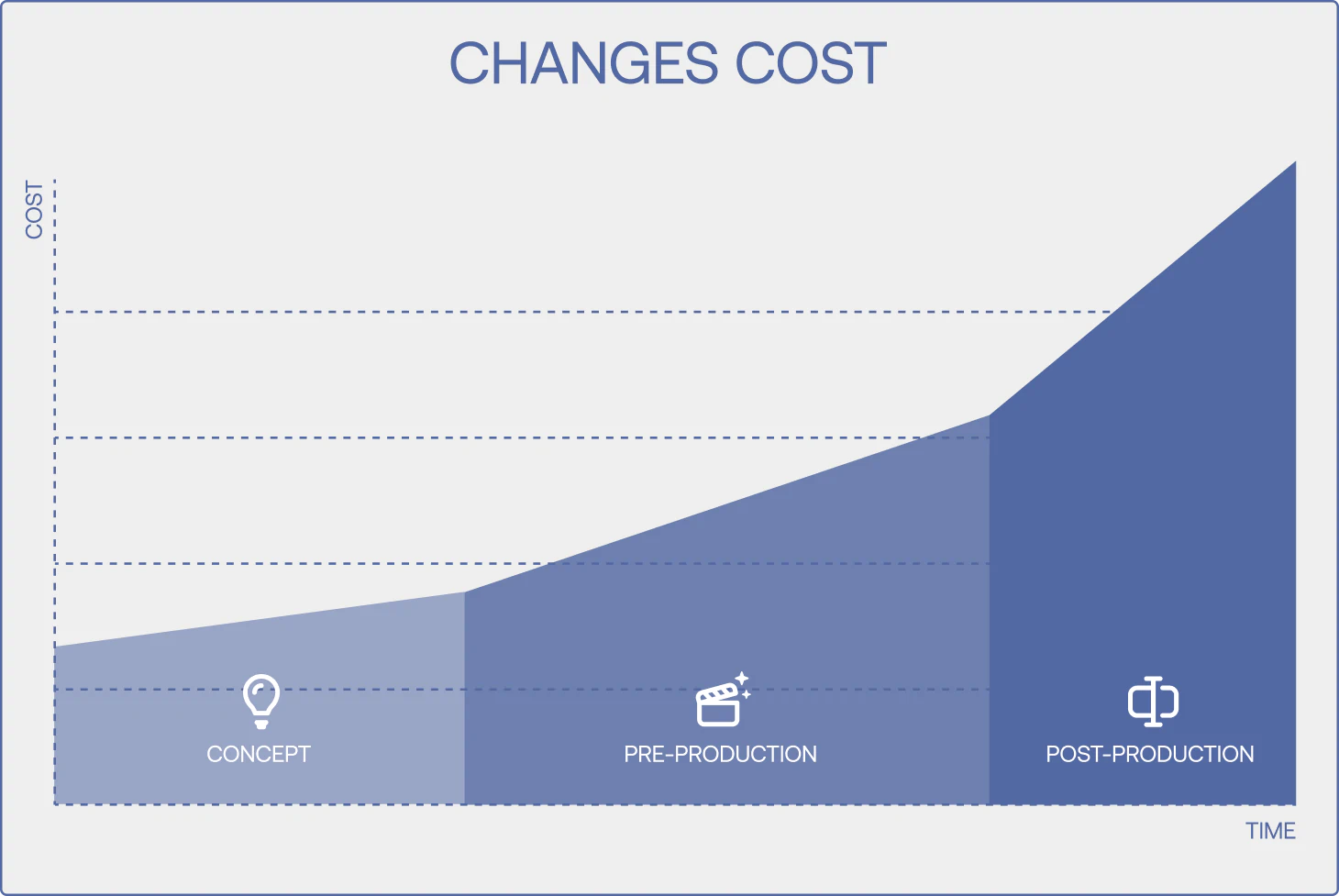
The answer: somewhere between 10 and 100 times more expensive than if that same change had been caught during the concept phase.
And that's not hyperbole. That's the reality of how production costs compound.
Why Late Changes Aren't Just "Annoying"—They're Exponentially Expensive
Every creative knows intuitively that late changes are costly. But most teams drastically underestimate just how much costs multiply as a project moves through production stages.
A script adjustment during concept development might take an hour of internal team time. That same adjustment after the shoot? Now you're looking at:
- Reshoot costs (crew, talent, location rebooking)
- Re-edit time (editor has to rework the timeline)
- New voiceover recording and mixing
- Legal re-review if messaging changed
- Delivery delays that push other projects back
- Cascading timeline impacts across dependent campaigns
Changes made in post-production cost 10 to 100 times more than changes made during concept development. What started as "just change the ending" becomes a substantial budget problem. Or worse—if talent isn't available for reshoots, if locations can't be rebooked, if the deadline is immovable—it becomes an impossible problem.
"A single late-stage change can ripple across edit, voiceover, legal, delivery… It's not just the time or the budget. It's the morale hit when your team has to redo work they already nailed once."
But here's what most teams miss: late changes aren't bad luck. They're a predictable outcome of how most creative workflows operate.
How Costs Compound Through Production Stages
Understanding why the cost multiplier exists requires looking at what's actually locked in at each stage of production.
Early Stage: Maximum Flexibility, Minimum Cost
During concept and pre-production, everything is still flexible. Creative direction, messaging, tone, pacing—all of it can shift without triggering hard costs.
A tone change here might require:
- Revising the creative brief
- Updating mood boards or storyboards
- Adjusting the concept presentation
No reshoots. No rework. Just iteration on ideas that haven't been executed yet.
This is when changes are inexpensive—sometimes just hours of internal labor.
Mid-Stage: Some Assets Locked, Costs Rising
Once production planning begins, costs start climbing. Scripts are finalized. Talent is booked. Locations are scouted. Shot lists are built.
A change at this point requires:
- Reworking production plans
- Potentially rebooking resources
- Communicating updates across multiple teams
- Adjusting timelines
You're not just changing an idea anymore. You're changing logistics that are already in motion.
Late Stage: Everything Locked, Maximum Cost Impact
By post-production, nearly everything is fixed. Footage is shot. Edits are timed to the frame. Voiceover is recorded to match specific visuals. Color grading is applied. Motion graphics are rendered.
A change here doesn't just affect one element—it cascades:
- Edit changes require re-timing the entire sequence
- VO changes need studio time, talent rebooking, new mixing
- Visual changes might require reshoots (often impossible by this point)
- Legal changes trigger new review cycles
- Timeline impacts affect delivery to clients, platform deadlines, dependent campaigns
This is where the 100x multiplier hits. You're not just redoing work—you're undoing decisions that were already executed and paid for.
The Real Root Cause: Lack of Visual Clarity
Here's the pattern most teams don't see:
Late changes happen when stakeholders finally see the actual creative—motion, pacing, tone, all of it—and realize it's different from what they imagined during the deck review.
This isn't a failure of alignment. It's a failure of visibility.
Stakeholders can't confidently approve what they can't see. When alignment happens through decks and mood boards—abstract formats that leave too much open to interpretation—everyone imagines something different.
Creative teams spend time defending concepts instead of refining them. And by the time everyone actually sees the same thing, production is already underway and changes are expensive.
The problem isn't that stakeholders change their minds. The problem is they never had enough clarity to make confident decisions in the first place.
What's Changing
The teams reducing late-stage rework costs aren't just being more disciplined about approvals.
They've recognized that the old model—linear stages with handoffs in between—was designed for an era when you had weeks between concept and delivery, when formats were limited, when rework was just "part of the process."
What's emerging now is different: workflows where teams can visualize creative direction continuously, not just at the end. Where stakeholders see motion and pacing early enough to give specific feedback when changes are still inexpensive. Where iteration happens throughout production, not as damage control after the fact.
This doesn't eliminate feedback or iteration. It changes when those things happen—moving them upstream to where they don't require expensive rework.
When teams can show stakeholders actual visual references, test motion, and align on what they're seeing rather than what they're imagining, late-stage "surprises" drop dramatically.
The cost multiplier doesn't disappear. But you stop triggering it.
The Real Fix Isn't More Discipline—It's Better Visibility
You can't prevent all late changes. Creative work evolves. Feedback is part of the process.
But you can dramatically reduce the expensive ones by solving for visibility earlier. When stakeholders can see what they're approving—not imagine it, not interpret a deck, but actually see motion, pacing, and creative direction—alignment happens faster and more confidently.
The 10x-100x multiplier is real. But it's avoidable.
The question isn't whether late changes are frustrating. The question is whether your workflow gives stakeholders enough visibility to avoid them.
{{blog-banner-static02}}


Maximize your creative potential with AI-powered tools
Maximize your creative potential with AI-powered tools





.png)


.png)