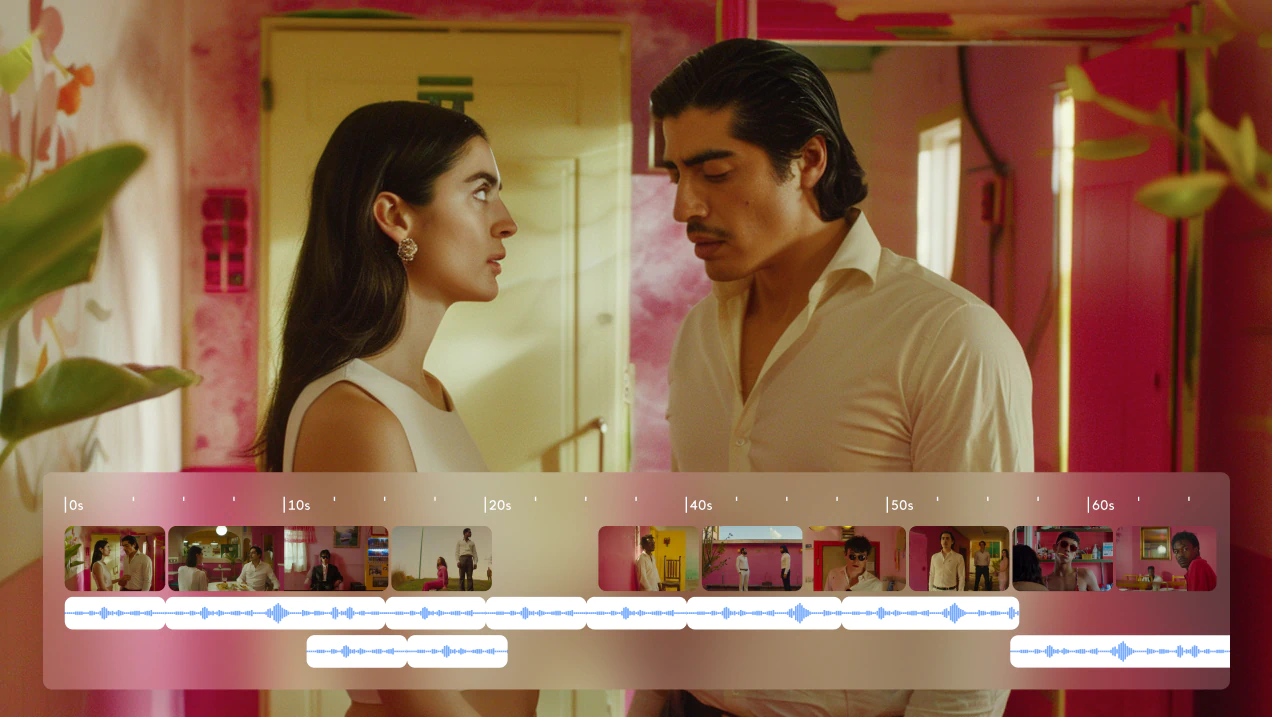

- AI video generators create complete videos from text prompts, images, or scripts using machine learning trained on millions of video examples
- Costs range from $0.50-$30 per minute for AI generation vs. $1,000-$50,000 per minute for traditional production—up to 90% savings
- Pricing models include subscription tiers, credit-based systems, and pay-per-use, with costs driven by resolution, duration, and complexity
- LTX Studio offers enterprise plans with unlimited generation, making it cost-effective for teams producing high volumes of video content
AI video generation has transformed from experimental technology into production-ready infrastructure that delivers professional results. But understanding what these tools actually cost—and what drives those costs—requires looking beyond monthly subscription prices.
This guide breaks down AI video generation costs in 2026, explains how the technology works, and helps you evaluate whether AI video tools make financial sense for your needs.
{{blog-banner-static03}}
What Is an AI Video Generator?
An AI video generator is a platform that creates complete videos from text descriptions, images, scripts, or other inputs using artificial intelligence. Instead of filming with cameras and editing manually, you describe what you want and the AI generates professional video content.
These tools don't just stitch together stock footage or templates. They generate original video content including character movements and expressions, camera angles and motion, lighting and atmospheric effects, scene composition and transitions, and synchronized audio and dialogue.
The output quality has improved dramatically. Modern AI video generators produce results that match or approach traditional production quality in many scenarios, making them viable for commercial use, marketing campaigns, and professional content.
Types of AI Video Generators
Different AI video tools serve different purposes. Text-to-video platforms like LTX Studio generate complete videos from written descriptions. Image-to-video tools animate static photos with realistic motion. Script-to-video systems transform screenplays into visual sequences. Avatar-based generators create talking head videos with AI presenters.
Understanding which type you need affects both capabilities and costs.
How Do AI Video Generators Work?
AI video generation uses deep learning models trained on millions of hours of video content. These models learn patterns in motion, composition, lighting, and storytelling from their training data.
The Generation Process
When you provide a text prompt, the AI breaks down your description into visual components—subjects, actions, settings, camera work. It then generates video frame by frame, predicting what each frame should contain based on your prompt and its training.
The process involves understanding your text description semantically, generating initial video frames from random noise, refining those frames progressively through multiple iterations, ensuring consistency across all frames, and adding motion, physics, and realistic movement.
More advanced systems like those in LTX Studio also handle character consistency across scenes, automatic lip sync for dialogue, and cinematic camera movements.
What Determines Generation Quality
Several factors affect output quality. Model sophistication matters—larger, better-trained models produce more realistic results. Prompt quality directly impacts outputs—specific descriptions yield better videos. Computational resources allocated to generation affect detail and realism. Video duration and complexity influence how well the AI maintains consistency.
This is why different AI video platforms produce noticeably different quality levels even when given identical prompts.
How Much Does AI Video Generation Cost?
AI video generation costs vary dramatically based on platform, quality, and usage volume. Understanding the pricing models helps you evaluate true costs.
Subscription-Based Pricing
Most AI video platforms use monthly or annual subscription tiers. Entry-level plans typically cost $10-30/month with limited generation minutes, basic features, and watermarked exports. Mid-tier plans run $50-100/month offering more generation time, HD exports, and removing watermarks. Professional plans cost $200-400/month with higher quotas, advanced features, and priority generation.
Enterprise plans use custom pricing based on volume, features, and support needs.
Credit-Based Systems
Some platforms sell credits that you spend on generations. Costs per video depend on resolution (720p vs. 1080p vs. 4K), duration (5 seconds vs. 60 seconds), and features used (standard vs. advanced generation).
For example, based on 2026 data, generating a 10-second video in 720p might cost 20 credits, while the same video in 1080p might cost 40 credits. Monthly subscriptions include credit allotments—typically 660-8,000 credits depending on tier.
Pay-Per-Use Models
A few platforms charge directly per video minute generated. Google's Veo 3 costs approximately $30 per minute. Basic AI tools can cost as little as $0.50-$2 per minute for standard quality.
This model works well for occasional use but becomes expensive at high volumes.
Cost Comparison: AI vs. Traditional Production
AI tools reduce costs by 90-99% for many use cases. A 10-video social media campaign might cost $89 with AI versus $100,000+ through traditional agencies.
What Drives AI Video Generation Costs
Understanding cost drivers helps you optimize spending:
Resolution and Quality
Higher resolution requires more computational resources. 4K generation costs significantly more than 720p. For social media, 1080p often suffices. For broadcast or premium content, 4K may justify the additional cost.
Video Duration
Longer videos cost more—both in credits and processing time. A 5-second clip uses fewer resources than a 60-second video. Plan content length strategically based on distribution platform requirements.
Generation Complexity
Complex scenes with multiple characters, intricate movements, or detailed environments require more processing. Simple product demonstrations cost less than elaborate narrative sequences.
Features Used
Advanced features like custom voices, specific style controls, or precision editing add costs. Basic generation is cheaper than using all available capabilities.
Revision and Iteration
Each generation attempt costs credits or time. Testing multiple variations increases total costs. The most cost-effective approach generates fewer, better-specified videos rather than many low-quality attempts.
{{blog-banner-video03}}
The Future of AI Video Generators
AI video generation technology advances rapidly. Capabilities that seemed impossible in 2024 became routine in 2025. This trajectory continues into 2026 and beyond.
Improving Quality and Realism
AI-generated video quality improves month over month. Physics simulation becomes more accurate. Human movements look more natural. Lighting and atmospheric effects achieve photorealism. The gap between AI-generated and traditionally filmed content continues narrowing.
Within 1-2 years, distinguishing AI-generated video from real footage will become difficult for most viewers in many scenarios.
Longer Video Generation
Current AI tools typically generate 5-60 second clips. Future models will handle longer-form content reliably—full scenes, complete sequences, even short films generated end-to-end.
This extends AI video generation from social clips and ads into narrative content, training videos, and long-form storytelling.
Better Creative Control
Precision controls improve constantly. Future tools will offer frame-level editing, scene composition with multiple controllable elements, style transfer from reference videos, and character consistency across unlimited duration.
Platforms like LTX Studio already provide directorial controls through features like Retake, and these capabilities will expand.
Cost Reductions Through Efficiency
As models become more efficient, generation costs decrease. Better algorithms require less computational power for the same quality. This means either lower prices or better quality at current price points.
The trend points toward AI video generation becoming increasingly affordable while quality continues improving.
Integration with Full Production Workflows
AI video tools will integrate more seamlessly with traditional production workflows. Use AI for pre-visualization and concept testing, generate B-roll and establishing shots, create variations for A/B testing, and supplement filmed footage with AI-generated elements.
This hybrid approach combines AI's speed and cost advantages with traditional production's irreplaceable human elements.
Use Cases For LTX Studio's AI Video Generator
LTX Studio serves enterprises and creative teams that need to produce original video content at scale. Here's how organizations use the platform.
Marketing and Advertising Campaigns
Generate advertising content faster than traditional production allows. Create dozens of variations for A/B testing, produce localized versions for different markets, maintain brand consistency across all campaigns through Elements, and adapt messaging quickly based on performance data.
Marketing teams can test creative concepts before committing to expensive traditional production.
Social Media Content at Scale
Social platforms demand constant fresh content. LTX Studio enables sustainable production by generating daily or weekly video content, creating platform-specific formats (16:9, 9:16, 1:1), testing different hooks and messaging, and maintaining consistent visual identity across all posts.
Produce social content without burning out creative teams.
Product Demonstrations and Explainers
Show products in action without complex filming. Generate demonstrations highlighting different features, create how-to content and tutorials, produce localized versions for international markets, and update videos instantly when products change.
For eCommerce and SaaS companies, AI-generated product videos keep marketing current without continuous production cycles.
Pre-Production and Storyboarding
Use LTX Studio's Storyboard Generator to visualize scripts before filming. Test camera angles and movements, show stakeholders what scenes will look like, refine pacing and composition, and identify production challenges early.
This pre-visualization saves money by catching issues before expensive production begins.
Training and Internal Communications
Create professional training content without filming. Generate scenario-based training videos, produce onboarding materials for new employees, create executive communications at scale, and update content quickly as processes change.
Internal video becomes affordable enough to use extensively rather than sparingly.
Episodic and Series Content
Maintain character and visual consistency across multiple episodes or installments using Projects for organization. Generate entire series with consistent branding, produce sequel content without reassembling cast and crew, and create extended narratives that traditional budgets wouldn't support.
LTX Studio Pricing for Enterprise Teams
LTX Studio offers enterprise plans designed for teams producing video at scale. Unlike credit-based systems that punish frequent use, enterprise pricing provides unlimited generation within your plan tier.
This predictable pricing model works better for organizations with consistent video production needs. You know your costs upfront rather than discovering overages when credit pools run dry.
Enterprise plans include unlimited access to all features including script-to-video, character generation, storyboarding, and editing, team collaboration with project management, brand consistency tools through Elements, priority generation and support, and custom integration options.
For organizations producing dozens or hundreds of videos monthly, unlimited generation plans often prove more cost-effective than credit-based alternatives.
Find out more on our pricing page.
Conclusion
AI video generation costs in 2026 range from affordable to premium depending on platform, quality, and usage volume. But even premium AI tools cost 90-99% less than traditional video production for comparable outputs.
The key is matching platform capabilities to your specific needs. For organizations requiring original video content at scale—marketing campaigns, training materials, social content, product demonstrations—AI generation delivers professional results at fractions of traditional costs.
LTX Studio provides comprehensive video creation capabilities from initial concept through final delivery. Generate content from scripts, maintain brand consistency automatically, collaborate across teams, and export in formats ready for any distribution channel.
Ready to explore AI video generation? Start creating with LTX Studio and experience how modern AI tools transform video production economics while delivering professional quality.


Maximize your creative potential with AI-powered tools
Maximize your creative potential with AI-powered tools





.png)