

- Scaling output almost always kills brand consistency — bold concepts become templates, distinctive voices go generic.
- Brand quality breaks down three ways: time pressure favors safe choices, brand review gets skipped, and teams interpret guidelines differently.
- Written guidelines aren't enough — descriptive language leaves too much open to interpretation.
- The fix: visual systems, continuous brand review, and aligning stakeholders on what they actually see.
- Storyboards that once cost $1,000+ and took 3 days can now be created for $15–$125 in minutes — moving visualization upstream changes everything.
- Scale and quality can coexist, but only with workflows designed for both.
Your brand looked flawless at 10 posts per month. Distinctive voice. Consistent aesthetic. Every asset felt intentional.
Then demand tripled. Now you're producing 30+ posts, weekly video content, animation assets, and platform-specific variations. The volume is there. But somewhere along the way, your brand stopped feeling like yours.
The bold concepts became templates. The distinctive voice became generic. The intentional aesthetic became "whatever we can ship on time."
This is the scaling trap: more output almost always means less consistency. But it doesn't have to.
Why Scale and Quality Feel Mutually Exclusive
Ask most creative leaders whether they can scale output without sacrificing brand quality, and you'll get a resigned laugh.
Because historically, scaling creative has meant choosing:
- More volume or more polish (rarely both)
- Meeting deadlines or protecting brand standards (but not consistently)
- Custom creative or realistic timelines (pick one)
The math seems impossible. If producing one high-quality video takes your team two weeks, how do you produce five without adding headcount or extending timelines?
Most teams respond to scale pressure the same way: they simplify. They templatize. They make compromises.
And it makes sense—when you're juggling too many deliverables with too few resources, brand integrity becomes negotiable. Teams don't want to cut corners. They're forced to.
But here's what's changed: scale and quality are no longer mutually exclusive. Teams that understand how brand consistency actually breaks down—and where modern workflows create new possibilities—are proving you can do both.
The Three Ways Brand Quality Breaks Down at Scale
Understanding where brand consistency fails under pressure reveals what needs to change.
1. Creative Decisions Get Made Under Time Pressure
When deadlines are tight and the queue is long, teams don't have the luxury of iteration. They make faster decisions—which almost always means safer decisions.
Instead of exploring three directions and refining the strongest, teams go with the first "good enough" concept. Instead of testing bold messaging, they default to what's worked before. Instead of custom assets, they pull from the template library.
These aren't bad choices individually. But multiply them across dozens of deliverables, and your brand starts to feel formulaic.
The problem isn't lack of creativity. It's that time-pressured workflows punish risk-taking. And distinctive brands require creative risks.
2. Brand Review Gets Bypassed for Speed
Most teams have brand guidelines. What they don't have is time to apply them consistently when volume is high.
A campaign that would normally go through three rounds of brand review gets compressed to one. The final review happens after production is already committed, when changes would be too expensive. "Good enough" replaces "on-brand" because there's no bandwidth left to fix it properly.
The result: brand drift. Not because standards don't exist, but because process pressure makes them optional.
3. Different Teams Interpret Brand Guidelines Differently
Brand guidelines say "bold but approachable." What does that actually look like in motion?
When different team members are executing across disconnected tools—one person handling social, another on video, another on animation—interpretation varies. Without shared visual references, everyone's version of "bold but approachable" looks slightly different.
Multiply that across 30 deliverables per month, and inconsistency compounds. Your brand doesn't feel cohesive because it's being interpreted through multiple lenses across fragmented workflows.
A Framework for Scaling Without Compromising
Teams that successfully scale while maintaining brand quality aren't just "being more careful." They've changed how brand consistency gets established and maintained.
Start with Visual Systems, Not Just Written Guidelines
Brand guidelines that rely on descriptive language ("energetic," "premium," "playful") leave too much open to interpretation.
Teams that scale successfully translate brand standards into visual systems: specific color palettes, motion styles, typographic treatments, pacing templates. When brand becomes visual reference rather than written description, interpretation gaps shrink.
Make Brand Review Continuous, Not Sequential
Instead of treating brand review as a gate at the end of production, embed it throughout. When teams work in connected environments where brand leads can see work evolving in real-time, corrections happen early—when they're cheap and fast.
This doesn't mean more meetings. It means better visibility into work in progress.
Align on What You See, Not What You Imagine
The biggest source of brand inconsistency at scale isn't lack of standards. It's that different stakeholders are visualizing those standards differently.
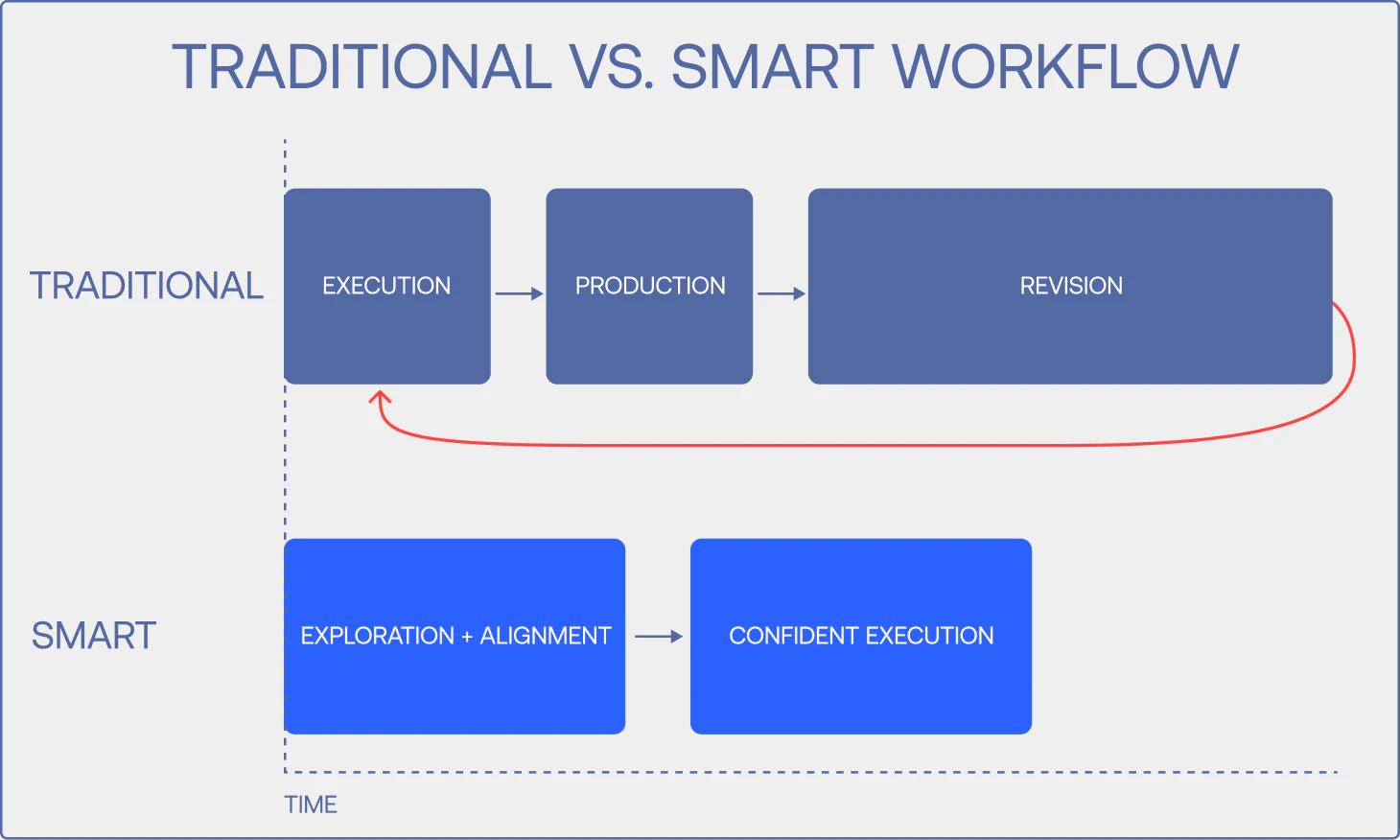
When alignment happens through actual visual references—motion tests, style frames, rendered examples—everyone aligns on the same interpretation. "Bold but approachable" stops being subjective when you can point to visual proof of what that means.
What's Enabling This Shift Now
For years, the trade-off between scale and quality felt unavoidable because visualizing creative work was expensive and time-consuming.
Creating mockups for every concept? Too slow. Building motion tests for stakeholder alignment? Too costly. Maintaining visual brand consistency across dozens of deliverables? Required too much manual oversight.
But workflows have evolved—and this is exactly what LTX was built to enable.
When teams use LTX to establish brand direction, they're working with actual motion and visual references from the start, not waiting until post-production to see what something looks like. The average storyboard used to cost $1,000+ and take 3 days. With LTX, teams create storyboards with actualized visual references for $15-$125 in minutes.
That's not just a speed improvement. That's a fundamental shift in when visualization happens and what it costs—which changes when brand alignment can happen.
When brand teams, creative leads, and stakeholders can all see work evolving in a connected environment—testing variations, refining direction, aligning on visual standards—brand consistency becomes easier to maintain at scale, not harder. They're not checking brand compliance after assets are finished. They're building brand integrity into the workflow from the start.
This shift doesn't require more team members or longer timelines. It requires workflows where teams can visualize brand application across multiple assets, iterate quickly, and align stakeholders on what they're seeing rather than what they're imagining.
When visualization moves upstream and becomes continuous rather than sequential, scale stops forcing compromises.
The Real Trade-Off
Scale will always create pressure. Deadlines will always be tight. Resources will always feel limited.
But the trade-off between volume and quality isn't permanent. It's a symptom of workflows that weren't designed for AI-era output demands.
Teams producing significantly more content than they were a few years ago—with the same budgets and timelines—can't rely on processes designed for sequential, low-volume production.
The question isn't whether you can scale output. The question is whether your workflows support scaling without forcing your team to choose between hitting deadlines and protecting your brand.
More output doesn't have to mean less consistency. It just requires workflows designed for both.
{{blog-banner-static02}}


Maximize your creative potential with AI-powered tools
Maximize your creative potential with AI-powered tools







.webp)
.png)